Internal-combustion vehicles could remain the majority for a long time. According to the EIA (U.S. Energy Information Administration), by 2050 the world could count 2.21 billion light vehicles, of which only 31% would be fully electric.
Based on this projection, 1.52 billion combustion-engine cars could still be on the road in 2050. More than today. Regardless of their powertrain type, all these vehicles will be – or nearly all – built between 2025 and 2050.
Valvijet’s objective is to reduce fuel consumption and CO2 emissions of combustion-engine vehicles by 12 to 13% on average, at the lowest possible cost. This reduction could even exceed 15% for certain vehicles. The implications are significant: in 2050, if the gasoline consumption of all combustion cars fell by 13%, global automotive CO2 emissions would decrease by 450 Mt per year, and oil consumption by $120 billion (based on $100/barrel and 12,000 km/year).
For a powertrain to be both economically and environmentally effective, it must achieve broad market acceptance. Reducing CO2 emissions efficiently therefore requires bringing low-carbon vehicles to market “vehicles that people need, want to buy, and can afford to buy,” in the words of Antonio Filosa, the new CEO of Stellantis.
In a tight economic context, purchasing power is the main barrier to adopting new powertrains. Valvijet will contain vehicle sale prices and reduce the TCO (total cost of ownership). It is a short-term solution to manufacture efficient, affordable, attractive, and competitive low-consumption cars. Its production relies on industrial infrastructures, competencies, and know-how that are essential for prosperity and sovereignty.
Valvijet is among the rare technological strategies able to significantly reduce CO2 emissions without constraining the market or suffocating the economy.
Because although electrification is inevitable, it is not the only path. Valvijet is a complementary pathway with global reach. It can support a transition whose exact form and pace cannot be fully anticipated.
Valvijet combines the qualities required for broad success: low cost per gram of CO2 avoided, significant fuel-consumption reduction, and excellent transparency in real-world use.
Valvijet is an add-on technology applicable to any hybrid or non-hybrid vehicle with low investment requirements.
The CO2-reduction potential of Valvijet can reach 15% or more on WLTP for a large modern vehicle and be at least 6% for an already highly efficient full hybrid. This reduction can be delivered at a cost between €7 and €42 per gram of CO2/km, far below the €95 penalty per excess gram of CO2 set by the EU’s CAFE regulation (Corporate Average Fuel Economy).
Another advantage: Valvijet can be commercialized in less than 5 years.
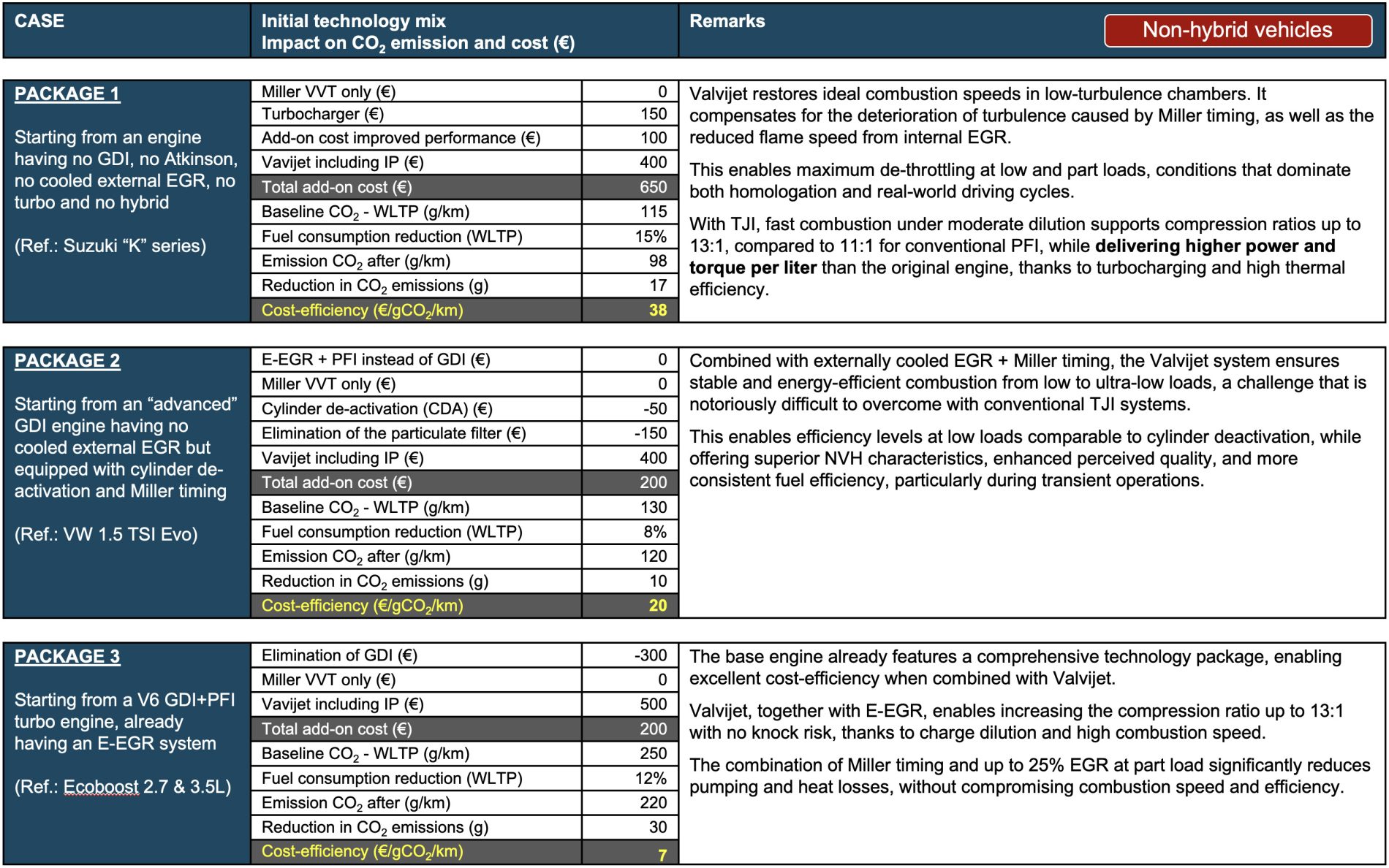
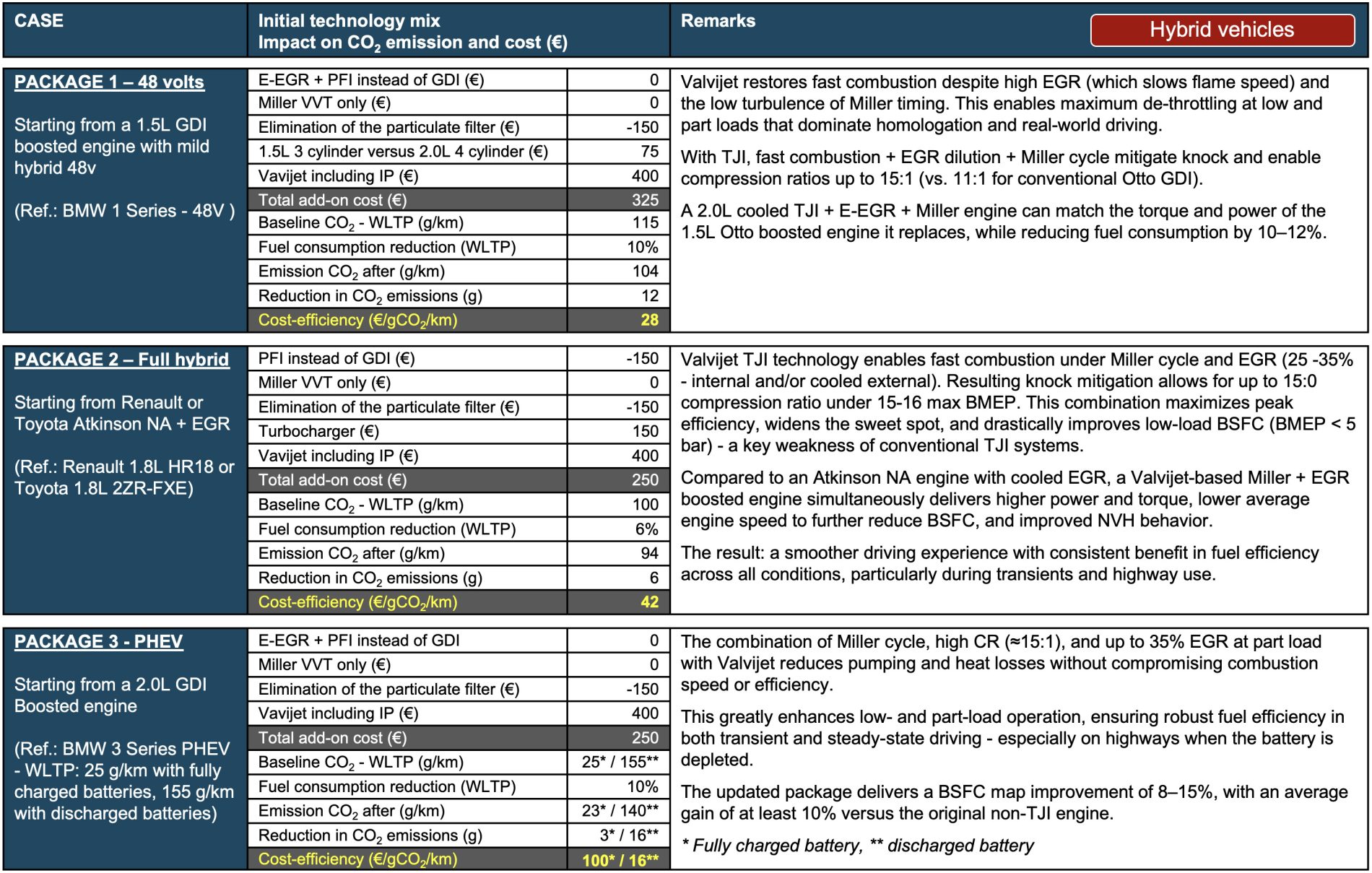
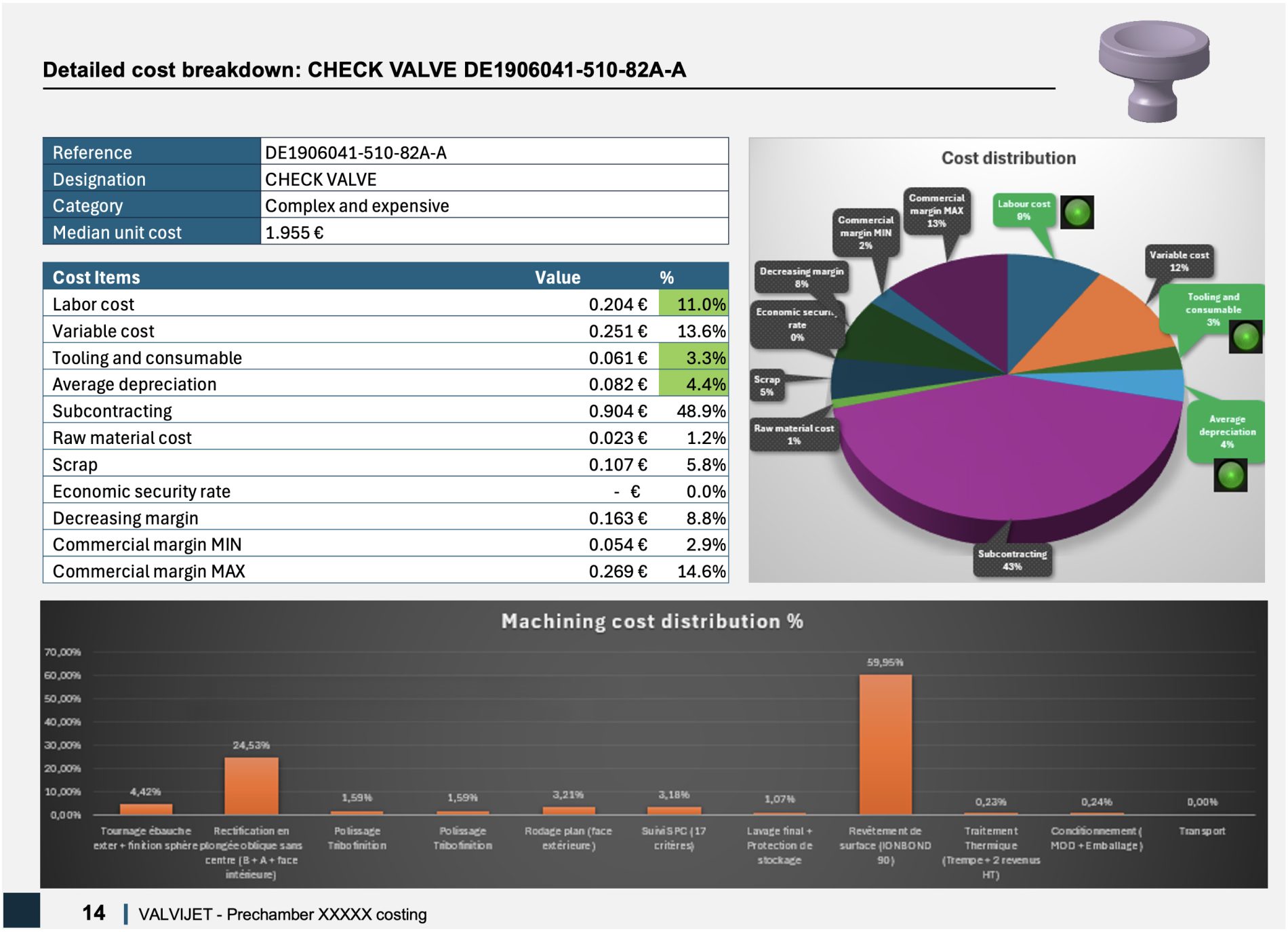
The Valvijet costs shown in these tables include intellectual-property expenses that are not expected to continue beyond 2045. The “manufacturing” portion included in these costs comes from a very detailed component-by-component study conducted in 2025 by a major French institution together with several industrial partners. From SOP onward, these costs can only decrease thanks to industrial learning and optimization:
Turbulent Jet Ignition (TJI) is without a doubt the next technological leap for automotive combustion engines.
To be efficient across the full operating range and remain compatible with simple and low-cost after-treatment (3-way catalyst), TJI requires compressing air, mixing it homogeneously and in precise proportions with fuel, and injecting the resulting gas mixture into a pre-chamber with maximum flexibility.
Without these functions, TJI will remain a marginal strategy reserved for high-performance engines, or a wishful concept. Valvijet provides the components that enable these functions: a world first.
Valvijet components are cost-effective and easy to integrate into a vehicle.
They will be outsourced to suppliers.
In addition to the essential functions required for large-scale TJI deployment, Valvijet adds a valve that ensures the pre-chamber is free of residual burnt gases at the start of every cycle. This innovation eliminates the main barrier to adopting active pre-chambers in automotive applications: poor low-load performance, precisely where WLTP and real-world driving (RDE) CO2 stakes lie.
Thus, Valvijet neutralizes all the barriers that have so far prevented TJI from being industrialized and commercialized:
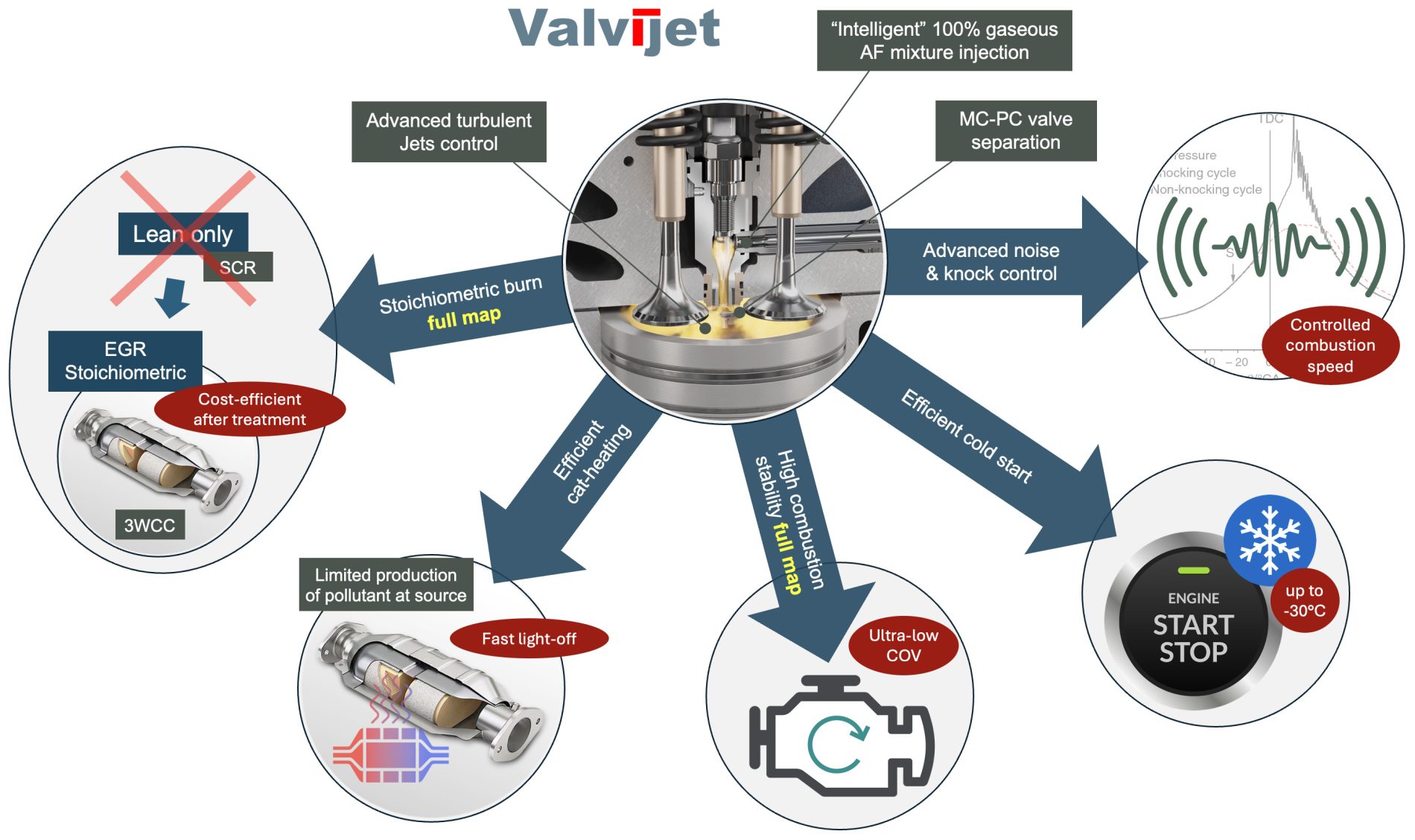
Valvijet can equip any automotive engine with minor adaptations to the cylinder head and combustion-system geometry. This is not a “retrofit”: these adaptations lead to an entirely new generation of engines designed to fully exploit TJI.
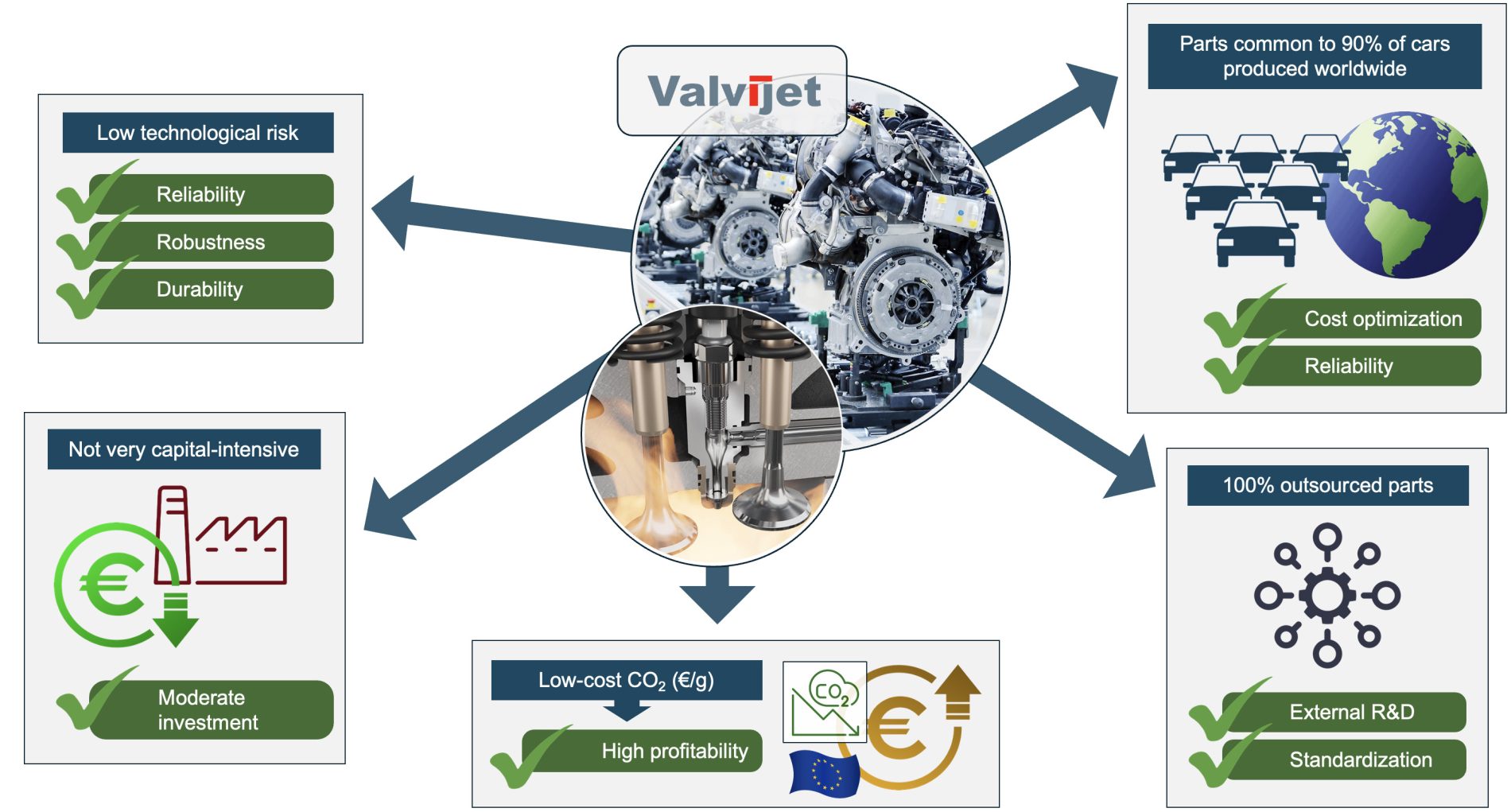
With low CAPEX, Valvijet will deliver strategic and commercial advantages of the highest order. Its highly standardized components will be sourced by automakers from suppliers:
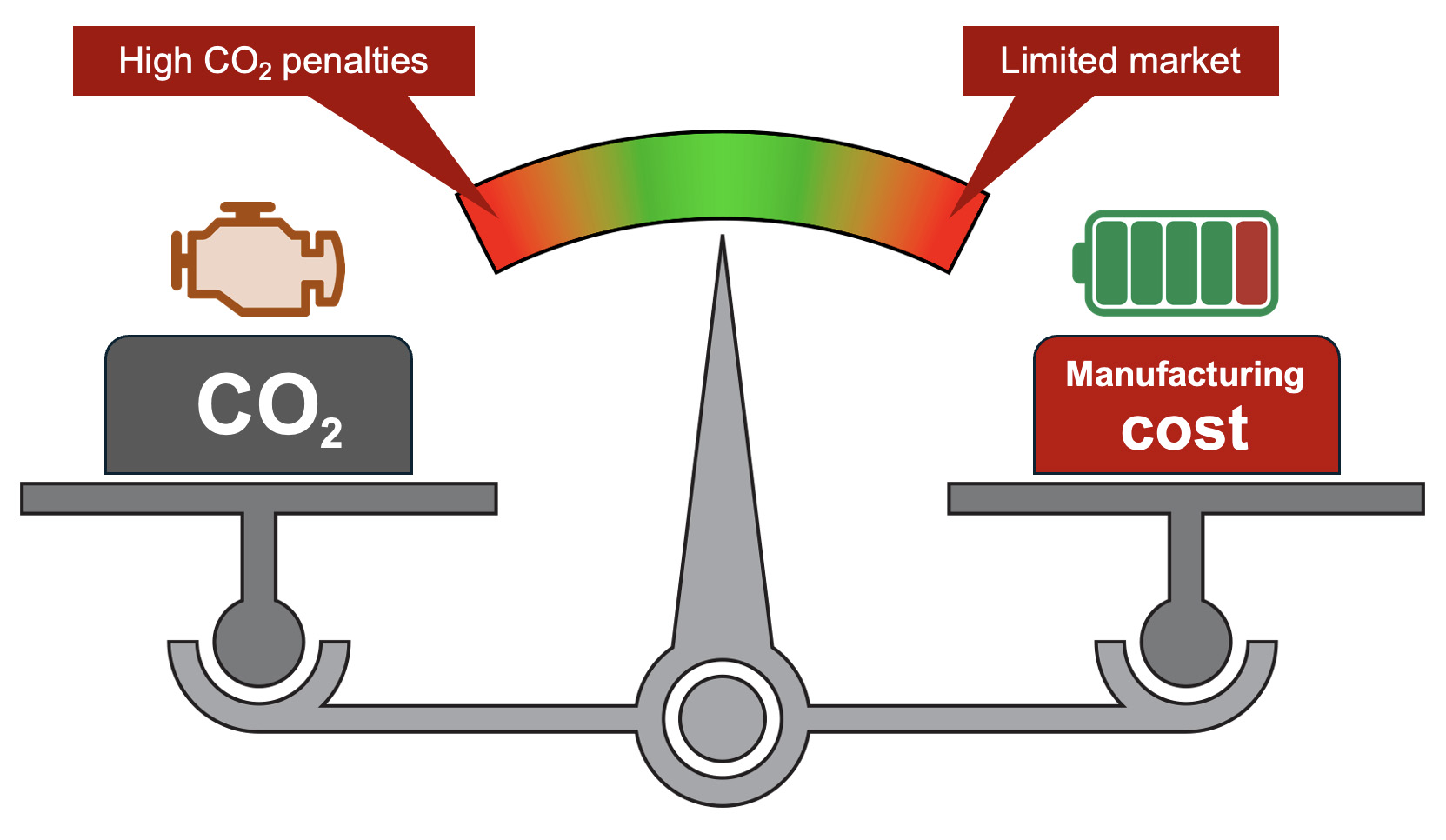
By reducing CO2 emissions per km at a lower cost, Valvijet will enable new trade-offs between CO2 emissions and sale price. Cheap-to-produce vehicles are notoriously expensive in CO2 penalties. Those that emit little CO2 are costly to manufacture.
Faced with stringent regulation, automakers invest in expensive but long-term-viable technologies: electric, hybridization. This is far more sensible than paying CO2 penalties. However, customers are discouraged by skyrocketing prices. This creates a dilemma for everyone: the manufacturer and the customer. The latter waits. The market contracts, the vehicle fleet ages, and the environment gains little.
Valvijet will offer new levers to manage this dilemma.
Indeed, Valvijet will enable the production of engines that deliver high efficiency in normal driving conditions, without electric assistance. Equipped with a 48-volt mild-hybrid system, the CO2 emissions of TJI-Valvijet vehicles could approach - or even match - those of a full hybrid. The result: hundreds or even thousands of euros saved per vehicle manufactured.